Best STEM Science Kits for Chemistry, Rob otics, and Physics Learning
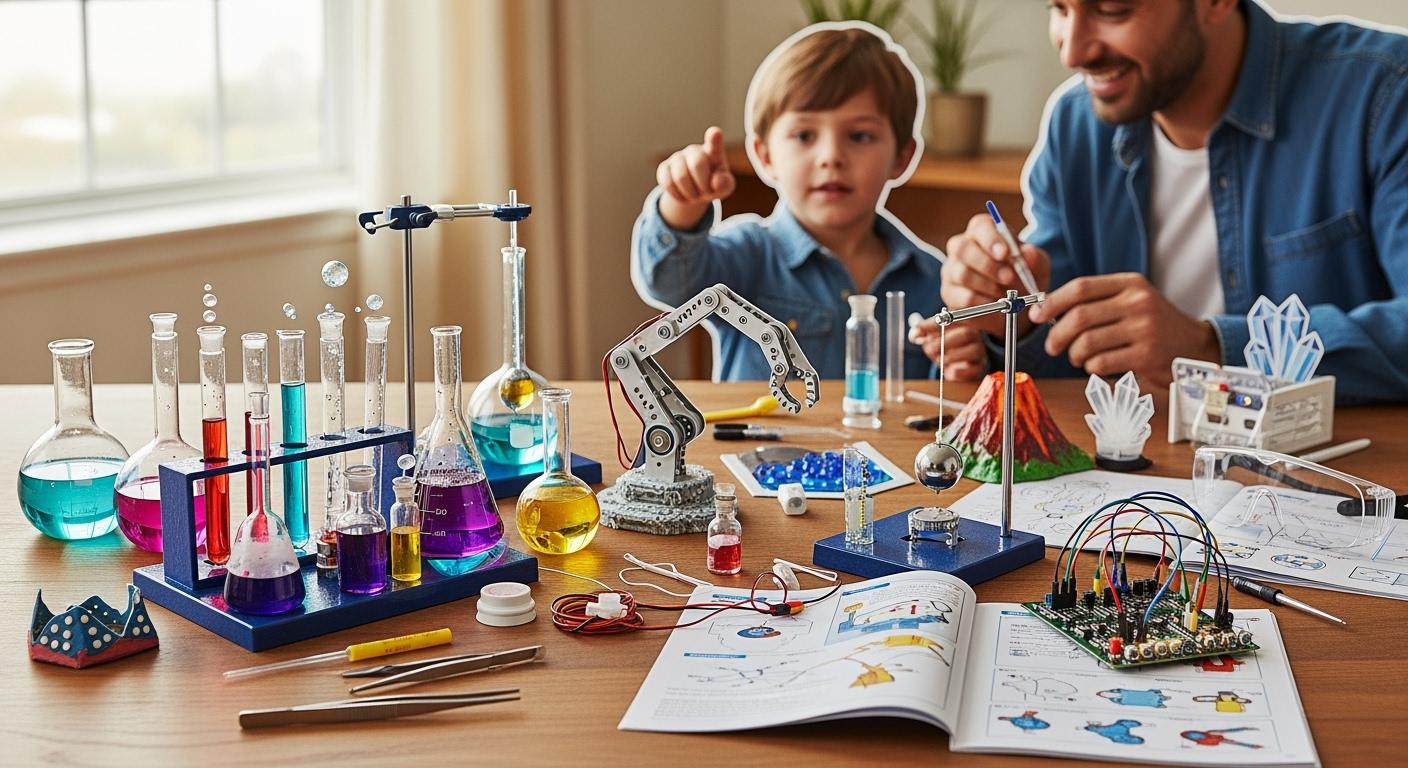
If you want to do hands-on science, there are great choices. You can look at STEM science kits like the Doodling Shake Bot STEM Kit, Magic Rocks Crystal Growing Science Kit, and Battery-Powered Balancing Robot DIY STEM Kit. You can do things like grow crystals, build robots, or make simple circuits. Many kits, like those from Home Science Tools, have easy steps and safety rules. When you choose a kit, think about your age, what you like, and what you want to learn. Having fun and staying safe are always most important with STEM kits!
Kit Name | Age | Price | Customer Reviews |
|---|---|---|---|
Doodling Shake Bot STEM Kit | 14+ | $4.95 | 13 |
Battery-Powered Balancing Robot DIY STEM Kit | 14+ | $5.55 | N/A |
Simple DC Motor DIY STEM Kit | 14+ | $5.55 | N/A |
Wire Maze Electricity DIY STEM Kit | 14+ | $5.55 | N/A |
Magic Rocks - Crystal Growing Science Kit | 13+ | $6.50 | N/A |
Hand-Crank Generator DIY STEM Kit | 14+ | $6.50 | N/A |
Solar-Powered Model House DIY STEM Kit | 14+ | N/A | 1 |
Key Takeaways
STEM kits let you learn by doing activities in chemistry, robotics, and physics. They make science fun and interesting.
Pick a kit that matches your age, what you like, and what you want to learn. This helps you have a good time.
Safety is very important. Always look at the age rules and safety tips before you use any STEM kit.
STEM kits help you build important skills. You can get better at solving problems, working with others, and being creative by doing projects.
Try different kits to see which one works best for you. Some people like fast experiments, while others like harder builds.
Best STEM Science Kits for Chemistry

Chemistry Kits for Kids
Do you want chemistry to be fun for kids? There are many STEM kits that make science feel like an adventure. Kids enjoy doing experiments with their hands. They like to watch things fizz, bubble, or change color. The Mega Stunning Science Chemistry Kit lets you make foamy reactions. You can also erupt a geyser and launch a rocket with gas. Crystal growing kits are good if you want to see cool changes. You get supplies for seven crystal experiments. There is also a display case for your crystals. Volcano science kits are also popular. You can build a volcano and make it erupt with real volcanic rocks.
Here are some favorite chemistry kits for kids:
Experiment Type | Description |
|---|---|
Crystal Growing Kit | You get supplies for seven crystal experiments and a display case. |
Volcano Science Kit | You get everything to build and erupt a volcano, including volcanic rocks. |
Mega Stunning Science Chemistry Kit | You can make fizzing reactions, erupt geysers, and launch rockets with gas. |
Thames and Kosmos Chem C500 | You can do 28 classic experiments, like acids, bases, and invisible ink. |
You can buy these STEM kits from brands like Thames & Kosmos and Home Science Tools. These brands use safe materials and give clear instructions. You can feel sure your child is safe. Most kits for kids are for ages 8 and up. Prices usually start at about $4.00.
Chemistry Kits for Teens
If you want to challenge teens, there are more choices. Teens like STEM kits with harder experiments and real lab skills. The Science Mad! Chemistry Lab is a top pick for ages 10 and up. It has over 80 experiments, 10 chemicals, glass test tubes, a spirit burner, and safety glasses. Some experiments need extra things like methylated spirit or distilled vinegar. You may need to get these supplies.
MEL Science kits are also great for teens. These kits are for ages 10 to 14. You get new experiments every month, so it stays interesting. MEL Science kits cost about $34.90 each month. Other kits for teens cost from $4.00 to $30.00. The price depends on how many experiments and how hard they are.
Here are some chemistry kits for teens:
Science Mad! Chemistry Lab: Over 80 experiments, ages 10+, comes with lab tools and chemicals.
MEL Science Kit: Monthly subscription, ages 10–14, new experiments every month.
Thames and Kosmos Chem C500: 28 classic experiments, acids, bases, and invisible ink.
Educational Benefits of Chemistry STEM Kits
STEM kits for chemistry teach more than mixing chemicals. You learn to solve problems and think like a scientist. You also learn how things work. Many STEM kits help you ask questions and try new ideas. Escape the Classroom: Contamination Busters lets you learn about water science and water treatment. MEL Science kits use comics to teach you. You can build real devices and see how chemistry changes the world.
Here is a table with some learning outcomes from STEM kits:
STEM Kit | Educational Outcomes |
|---|---|
Escape the Classroom: Contamination Busters | You learn about water science with safe experiments and understand water treatment. |
MEL Science STEM Kits | You build problem-solving skills and make working devices with hands-on projects. |
You also learn to be safe, follow directions, and work by yourself. These skills help you in school and in life. Brands like National Geographic, Thames & Kosmos, and Playz make good STEM kits. They give clear steps, safe materials, and fun experiments.
If you want chemistry to be exciting, STEM kits are a great choice. There are kits for every age and price, so you always have new ways to learn and explore.
Top STEM Kits for Robotics
Robotics Kits for Beginners
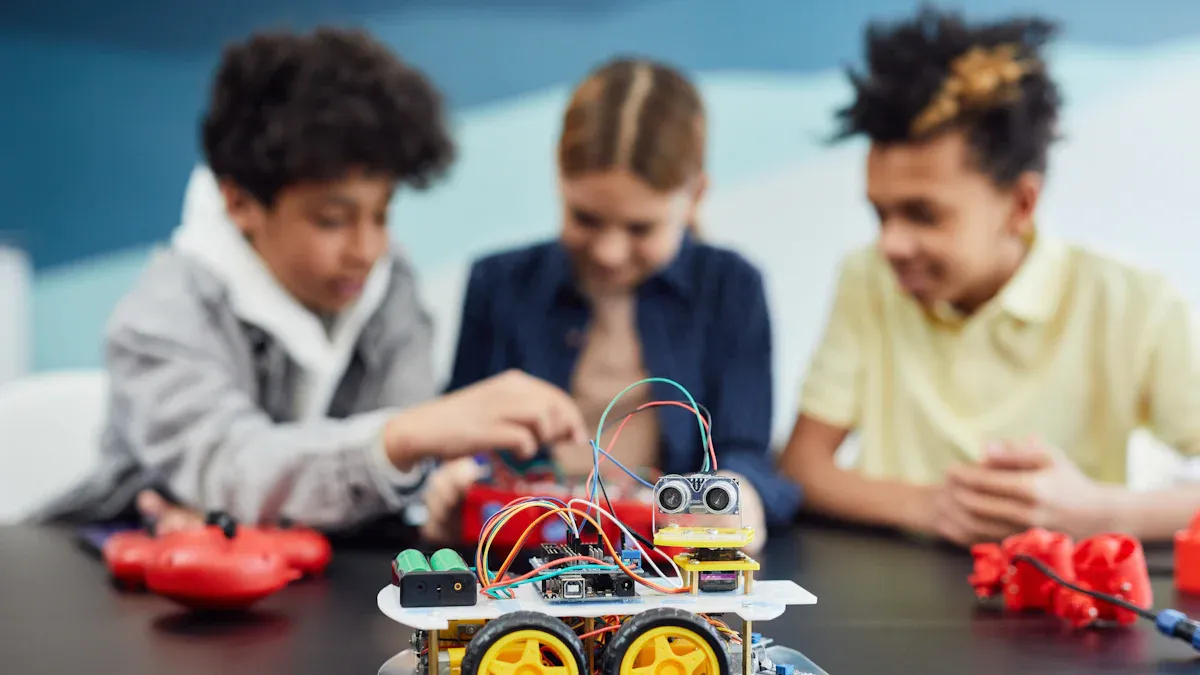
Do you want to build your first robot? Beginner robotics kits are a good way to start. You can put together simple robots and learn coding basics. These kits show you how technology works. You get to use your hands and be creative. They help you work with others and solve problems. You can also try new ideas and have fun.
Here are some beginner robotics kits you might enjoy:
ActivityBot: This kit lets you change your robot as you learn. You can start easy and add more as you get better.
Shield Bot: This robot comes ready to use and works with Arduino. It is quick to set up and has a big online group to help.
Surveyor Robot: This kit has a control board for all skill levels. You can even watch live video from your robot.
4WD ATV Robot Chassis Kit: You can build and take apart this robot fast. It is great for class projects and contests.
TurtleBot2: This robot uses ROS and helps you learn mapping. You can try more advanced skills with it.
NAO Humanoid Robot: Many schools use this robot for teaching. It is also good for special needs classes.
When you use these kits, you learn coding steps like loops and conditions. You get to play and think of new ways to use your robot. These kits help you work with friends and share your ideas.
Tip: Pick a kit that fits your age and what you like. Most beginner kits are for ages 8 and up. Prices go from $30 to $200, based on what the kit can do.
Robotics Kits for Intermediate Learners
Do you want to try harder robot projects? Intermediate kits give you more to do. You can build robots with sensors and microcontrollers. These kits teach you about design and electronics.
Here are some popular intermediate robotics kits:
Kitronik Smart Greenhouse Kit: You learn about plants and use micro:bit to control sensors.
Kitronik ARCADE for MakeCode Arcade: You make games and learn more coding.
Kitronik LAB:bit: This kit gives you hands-on work with micro:bit and electronics.
Kitronik Simple Robotics Kit: You build a robot and see how motors and sensors work.
Kitronik :MOVE Motor: This kit is a fun way to learn about buggy robots.
Kitronik Autonomous Robotics Platform: You use Raspberry Pi Pico to build and code robots.
Here is a table that shows what you learn with these kits:
Module | Focus Area | Description |
|---|---|---|
1 | Advanced Coding | Learn C language basics with ready robots. |
2 | CAD Design & Mechanics | Make parts with CAD and 3D printing, then build your robot. |
3 | Microcontrollers | Program robots with microcontrollers for tasks. |
4 | Capstone Project | Use design, building, electronics, and coding in one big project. |
Intermediate kits usually cost $50 to $400. Some kits, like Magician Lite, have software and hardware for ages 5 to 16. Others, like Magician E6 and CR5 robotic arm, have features like collision detection. You can use these kits for school, contests, or just for fun.
Note: Intermediate kits help you learn logic and engineering. You also learn to design, build, and code robots by yourself.
Robotics Kits for Teens and Adults
Do you want a bigger challenge? Advanced robotics kits let you build complex robots. You can work on bionic arms, robot hands, and snap circuits labs. These kits teach you about machines, coding, and design.
With advanced kits, you:
Solve problems by trying different ways.
Work with others on group projects.
Use STEM ideas in real life.
Build your thinking and logic skills.
Get better at using your hands.
Learn to keep going when things get hard.
You can use these kits in science and math classes. They help you learn about robots, coding, and how machines work. Some kits, like Magician robot and M1 Pro, have 3D printing and laser engraving. These kits are good for teens and adults who want to learn more.
Tip: Advanced kits cost from $200 to $1,500. Pick a kit that matches your skills and what you want to learn. You can use these kits for research, class, or just for yourself.
Robotics kits make STEM learning fun and hands-on. You get to build, code, and try out real technology. There is a kit for every skill level. These kits help you learn science, technology, engineering, and math. You also learn to work with others and solve problems.
If you want to try more, you can look at technology, engineering, or math kits. Each kit gives you new ways to learn and grow with STEM.
STEM Physics Kits
Physics Kits for Young Learners
You can start learning physics with kits for younger kids. These kits make energy, motion, and forces fun to learn. If you like to build, Magna-Tiles let you play with shapes and magnets. Marble runs, like Gravitrax, show how gravity and motion work. You design tracks and watch marbles move. K’NEX Education Force and Newton’s Laws Set helps you see how forces and energy move things. Magnet kits let you see how magnets pull and push. Motion and energy sets teach about kinetic and potential energy. You can use roller coasters and catapults. Rocket kits let you launch small rockets. You learn about thrust and aerodynamics.
Magna-Tiles: Build shapes and learn about magnetism.
Marble runs: Try gravity and motion with marbles.
K’NEX Education Force and Newton’s Laws Set: Explore forces and energy.
Magnet kits: Watch magnets pull and push.
Rocket kits: Learn about thrust and aerodynamics.
Physics Kits for Middle and High School
If you want harder projects, older student kits have deeper experiments. You can build solar cars and air-engine racers. These teach about energy and motion. Estes rockets help you learn aerodynamics and propulsion. Architectural engineering kits show how buildings stand and move. Some kits, like Science Kits for Middle and High School, let you test ideas with pendulums and other tools. The Focus on Middle School Physics Lab Kit has over 20 materials for 12 experiments. You learn about energy, friction, and Newton’s Laws. Real Science-4-Kids Physics Lab Kit gives you tools for college-level experiments. You use precision scales and other equipment.
Physics Kit | Description |
|---|---|
Science Kits for Middle and High School | Attach materials to pendulum bases and test physics concepts. |
Focus on Middle School Physics Lab Kit | Over 20 materials for 12 experiments, including energy, friction, and Newton’s Laws. |
Real Science-4-Kids Physics Lab Kit | 12 experiments with advanced equipment, covering college-level physics principles. |
Learning Outcomes with Physics STEM Kits
When you use physics stem kits, you get hands-on science. You learn to make lesson plans and teach physics ideas. You understand motion, forces, and electricity by building models. You also use electronics and programming in some kits. These activities help you connect science to real life.
Learning Outcome | Description |
|---|---|
You make plans to teach physics ideas. | |
Understanding of physics concepts | You learn more about motion, forces, and electricity. |
Hands-on experience | You build and use electronics and programming in projects. |
Physics stem kits make learning active and fun. You build, test, and find new ideas every time you use a kit. If you want to learn about engineering, energy, or motion, these kits help you do it.
STEM Kits Comparison Table
Picking the right science kit can be hard. You want a kit that matches what you like. It should fit your age and help you learn. Let’s see how chemistry, robotics, and physics kits are different. Each kit has something special about it. Some kits are messier than others. You will also learn different skills with each kit.
Here is a table to help you compare:
Feature | Chemistry Kits | Robotics Kits | Physics Kits |
|---|---|---|---|
Primary Focus | Chemical reactions and molecular behavior | Building, coding, and mechanical movement | Forces, motion, and mechanical principles |
Experiment Duration | Quick, instant results | Varies—some quick, some longer builds | Longer, multi-step building projects |
Skills Developed | Observation, measurement, following procedures | Coding, engineering, problem-solving | Problem-solving, spatial reasoning, engineering thinking |
Appeal Factor | Colorful reactions and “magical” changes | Moving robots and creative designs | Building satisfaction and mechanical understanding |
Mess Level | Can get messy with liquids and powders | Usually tidy, mostly solid parts | Generally tidy with solid components |
Repeatability | Limited by consumable materials | High—reuse parts and code | High—reuse parts for new builds |
Social Learning | Great for group experiments | Awesome for teamwork and sharing ideas | Excellent for collaborative building projects |
Age Suitability | Safe, simple reactions for younger kids | Kits for all ages, from beginners to teens | Simple machines for younger kids, advanced kits for older students |
Price Range | $4–$35 | $30–$1,500 | $10–$100 |
Educational Value | Strong science foundation, fun experiments | Teaches coding, engineering, and teamwork | Builds understanding of physics and engineering |
Tip: Chemistry kits are fun if you like fast and colorful results. Robotics kits are good if you want to build and code. Physics kits are great if you like building and figuring out how things work.
You may want to know what users and experts think about these kits. Here is a table to show you:
Product Name | User Rating (Simplicity) | User Rating (Value for Money) | Expert Evaluation |
|---|---|---|---|
Galt Giant Science Lab | 9.8 | 9.1 | Strong user satisfaction and educational value |
National Geographic Science Magic Kit | Competitive ratings | Reflects educational value | Supported by expert evaluations |
UNGLINGA kits | Competitive ratings | Reflects engagement | Supported by expert evaluations |
When you look at stem kits, think about what you want to learn. Some kits are better for working alone. Others are best for groups. There are science kits for every interest and skill level. Pick the kit that sounds most fun to you and start learning!
STEM Kits Buyer’s Guide
How to Choose STEM Science Kits
Picking the right kit can feel tricky, but you can make it simple. Start by thinking about what you like to do. Do you enjoy building, mixing, or coding? Choose a kit that matches your interests. Experts say you should look for toys that fit your age and skill level. If you love group activities, pick a kit that lets you work with friends. You want a kit that helps you solve problems, think in new ways, and use your hands.
Here’s a quick table to help you compare what matters most:
Criteria | Description |
|---|---|
Age Appropriateness | Make sure the kit fits your age and helps you learn new skills. |
Skill Development | Look for kits that build thinking, teamwork, and motor skills. |
Safety | Check that all parts are safe for your age group. |
Safety and Age Appropriateness
Safety comes first with any science kit. Always check the age range on the box. Manufacturers test kits for sharp edges, small parts, and safe materials. For younger kids, kits use solid pieces and avoid tiny parts. If you see labels like ASTM F963 or CE Marking, you know the kit meets safety rules. Watch out for kits with batteries, chemicals, or small screws if you’re shopping for younger children. Adult supervision is a good idea for tricky experiments.
Tip: Most kits list age groups like 3–4, 5–7, or 8–13 years old. Pick the one that matches your age.
Educational Value and Fun Factor
You want a kit that makes you excited to learn. The best stem science kits help you build skills in science, teamwork, and creativity. Look for kits that let you try new things and use your imagination. Open-ended kits give you more ways to play and learn. If a kit is fun, you’ll want to use it again and again. Hands-on learning helps you remember what you discover.
Cognitive skills: Solve problems and think critically.
Social skills: Work together and share ideas.
Emotional skills: Learn about feelings and empathy.
Motor skills: Build and move things with your hands.
Budget Considerations
STEM kits come in all price ranges. You can find simple kits for $15 or more advanced ones for $25. Some stores offer free shipping if you buy a few kits at once. If you want to give a kit as a gift, look for gift wrapping options. Check reviews to make sure the kit lasts and gives you good value.
STEM education grows your curiosity and skills. The right kit will make you want to explore, build, and learn more every day.
You get more than just fun when you use stem science kits. You build real skills in chemistry, robotics, and physics. Hands-on stem learning sparks your curiosity and helps you think in new ways. Research shows that these kits boost critical thinking and teamwork. You can inspire learning at home or in your classroom. Why not start your next science adventure today? 🚀
FAQ
What age is best for STEM science kits?
You can start with STEM kits as early as age 3. Most kits list the recommended age on the box. If you are older, you can try kits with harder experiments and more parts.
Are STEM kits safe to use at home?
Yes, most STEM kits use safe materials and clear instructions. You should always read the safety guide first. Adult supervision helps with tricky experiments.
Can you reuse STEM kits?
You can reuse many STEM kits, especially robotics and physics kits. Chemistry kits may need new supplies for some experiments. Always check the kit details before you buy.
How do STEM kits help you learn?
STEM kits let you build, test, and explore. You learn science, math, and engineering by doing hands-on projects. You also get better at solving problems and working with others.
What if you get stuck during an experiment?
Tip: If you get stuck, read the instructions again. You can ask a friend or adult for help. Many kits have online videos or guides to show you what to do.
See Also
Discovering Top Science Kits That Engage Young Minds
Key Factors Educators Consider in Selecting Science Kits
Choosing STEM Toys That Spark Curiosity in Children
